SvelteKit vs Nextjs in 2026: Choosing the Right Framework for Your Modern Web App
By Emmanuel Chinonso - Frontend Engineer and Technical Writer at Windframe
If you're diving into web development or looking to build your next project, you've probably heard about SvelteKit and Next.js. These two frameworks are powerhouses for creating modern web applications, but picking between them can feel tricky. In 2026, with web tech moving fast, it's more important than ever to choose something that fits your needs without overwhelming you.
This post breaks it all down simply. We'll cover what each framework is, how they stack up in key areas like speed and ease of use, their strengths and weaknesses, and when you might want to go with one over the other. Whether you're a total beginner or have some coding under your belt, I'll explain things step by step so you can make a smart choice. Let's get started!
Understanding Nextjs: The React Powerhouse
Nextjs has been a staple in web development since its launch in 2016 by Vercel. Built on React, it transforms the library into a full-fledged framework for creating server-rendered applications. By 2026, Nextjs is at version 16.1, incorporating React 19's advancements like improved server components and asynchronous APIs.1 This means developers can build apps that feel native while handling complex data flows on the server.
At its heart, Nextjs solves real problems like slow initial loads and poor SEO in single-page apps. It does this through server-side rendering (SSR), where the server generates HTML before sending it to the browser. This boosts performance and makes content crawlable by search engines. Static site generation (SSG) pre-builds pages at deploy time, ideal for blogs or marketing sites.

Key features in 2026 include:
-
App Router: The default since version 13, it supports nested layouts, loading states, and error boundaries without extra setup.2
-
Turbopack: Now stable, this bundler is up to 10x faster than Webpack for development and production builds.3
-
React Server Components (RSC): Run code on the server, reducing client-side JavaScript by up to 40% in some cases.4
-
Server Actions: Handle forms and mutations securely without separate API routes.
-
Partial Prerendering (PPR): Mix static and dynamic content on the same page for optimal speed.5
-
Built-in Optimizations: Automatic image compression, font subsetting, and script loading strategies keep Core Web Vitals high.
Nextjs shines in enterprise settings. Companies like Netflix and Hulu use it for handling massive traffic with dynamic content. 6 If your background is in React, transitioning is seamless, it's like React on steroids. But for absolute beginners, the React prerequisites (like hooks and context) add a learning step.
For a quick start, install via npx create-next-app@latest. Your first page is as simple as a file in the app/ directory exporting a component.
Diving into SvelteKit: The Compiler-Driven Challenger
SvelteKit builds on Svelte, a component framework introduced in 2016 by Rich Harris. Unlike libraries that run in the browser, Svelte compiles your code to efficient JavaScript at build time, minimizing runtime overhead. SvelteKit, its application framework, arrived in 2021 and by 2026 is powered by Svelte 5's "runes" system for reactive state management.7
SvelteKit focuses on performance from the ground up. It compiles away framework code, resulting in apps that are lighter and faster. This approach appeals to developers tired of bloated bundles. In 2026, updates include better Content Security Policy (CSP) support for hydration and enhanced adapters for platforms like Cloudflare.8

Standout features:
-
Runes: Signals-like reactivity that's predictable and shareable across components without props drilling.9
-
File-Based Routing: Like Nextjs, but with +page.svelte for UI and +server.js for APIs.
-
Load Functions: Fetch data server-side or client-side with ease.
-
Adapters: Deploy to Node, static hosts, or edge environments seamlessly.
-
Snippets and Custom Elements: Reusable UI blocks and customizable selects for modern browsers.10
-
Remote Functions: RPC-like calls that enhance progressively, blending client and server logic.11
SvelteKit is used by outfits like The New York Times for interactive elements, and its adoption is surging in startups for quick prototypes. 12
The syntax feels like enhanced HTML, making it approachable for newcomers. No virtual DOM means direct DOM updates, which can feel magical in interactive apps.To begin, run npm create svelte@latest. Components mix HTML, CSS, and JS in one file, with reactivity baked in.
Performance Showdown: Bundle Sizes and Speed
Performance is where SvelteKit often pulls ahead. Its compiler strips out unused code, leading to smaller bundles. A basic app in SvelteKit might gzip to 3-5KB, while Nextjs hovers around 85-130KB due to React's runtime.13
In benchmarks, SvelteKit handles 1,200 requests per second versus Next.js's 850.14
Nextjs counters with Turbopack for faster builds and RSC to shift work server-side. 15
For high-traffic sites, its Incremental Static Regeneration (ISR) caches dynamic pages, blending speed with freshness.
| Metric | SvelteKit | Nextjs |
|---|---|---|
| Bundle Size (Hello World) | 3-50KB gzipped | 85-130KB gzipped |
| Build Time | Under 10s for 50+ pages | 30s+ for similar |
| Requests/Second | ~1,200 | ~850 |
| Lighthouse Score | Often 90+ | Mid-70s without tweaks |
Real-world tests show SvelteKit edging out in time-to-interactive, crucial for mobile users. 16 If your app targets low-bandwidth areas, SvelteKit's lean nature wins.
Developer Experience: Ease of Use and Learning Curve
Developer happiness matters, happy coders ship faster. SvelteKit scores high here with its minimal boilerplate. No need for useState or useEffect; reactivity is declarative with $: labels or runes. 17 Surveys peg Svelte satisfaction at 71.47% versus React's 69.28%. 18
Next.js offers rich tooling, but React's concepts add complexity. Its App Router streamlines things, though migrations from older versions can sting.19 Vite powers SvelteKit's hot module replacement, often faster than Nextjs's Fast Refresh. For beginners, SvelteKit's HTML-like syntax lowers the barrier. Nextjs suits React vets or teams needing extensive libraries.
Routing and Data Handling: How They Flow
Both use file-based routing, but details differ. SvelteKit's +page.svelte and load() function handle data fetching uniformly on server or client. Nextjs provides getStaticProps, getServerSideProps, and async components for flexibility.
SvelteKit's remote functions shine for mutations, offering single-flight execution and progressive enhancement. Nextjs's Server Actions integrate tightly with forms.
| Feature | SvelteKit | Nextjs |
|---|---|---|
| Routing | +page.svelte, nested | app/ directory, layouts |
| Data Fetch | load() isomorphic | Multiple props methods |
| Mutations | Remote functions | Server Actions |
For data-heavy apps, Nextjs's cache primitives like use cache() provide granular control.
Rendering Strategies: Static, Dynamic, and Hybrid
Flexibility in rendering is key. Both support SSR, SSG, and client-side rendering (CSR). Nextjs adds ISR and PPR, prerendering static shells with dynamic holes.20 SvelteKit handles hybrids well but leans toward fine-grained control.
For e-commerce, Next.js's ISR refreshes product pages without full rebuilds. SvelteKit excels in static exports for cost-effective hosting.
Ecosystem and Community Support
Next.js dominates with over 120k GitHub stars and millions of downloads weekly. The React ecosystem means endless components, from UI kits like Material-UI to state managers like Redux.
SvelteKit's community is smaller (18k stars) but passionate, with growing libraries. 21 Job opportunities favor Nextjs, but SvelteKit's efficiency attracts niches like performance-critical apps.
SEO and Built-in Optimizations
Both are SEO stars with SSR. Next.js has metadata APIs and image optimization out of the box. SvelteKit requires more setup but achieves parity with plugins.
For global sites, Next.js's i18n support and edge rendering help.22
Full-Stack Capabilities: APIs and Backends
Build APIs inline: SvelteKit with +server.js, Next.js with Route Handlers. Pair with databases like Prisma for full-stack power. SvelteKit's lean approach suits serverless, while Nextjs handles enterprise integrations.
Code Examples: Hands-On Comparison
Let's see them in action. Fetching data for a user list.
Nextjs (app/users/page.tsx):
1import { fetchUsers } from "@/lib/api";23export default async function UsersPage() {4 const users = await fetchUsers();5 return (6 <ul>7 {users.map((user) => (8 <li key={user.id}>{user.name}</li>9 ))}10 </ul>11 );12}
This runs server-side, suspense-ready.
SvelteKit (+page.svelte):
1<script context="module">2 export async function load({ fetch }) {3 const res = await fetch('/api/users');4 const users = await res.json();5 return { props: { users } };6 }7</script>89<script>10 export let users;11</script>1213<ul>14 {#each users as user}15 <li>{user.name}</li>16 {/each}17</ul>
Reactive, compiled to efficient JS.
SvelteKit's version is concise, with built-in reactivity.
Real-World Case Studies
Next.js powers TikTok's dynamic feeds, leveraging ISR for personalized content. SvelteKit drives interactive NYT graphics, where bundle size matters for quick loads.
A startup MVP: SvelteKit got one to market in weeks, thanks to fast iteration. An enterprise dashboard: Next.js's ecosystem handled integrations smoothly.
Pros and Cons: Weighing the Trade-Offs
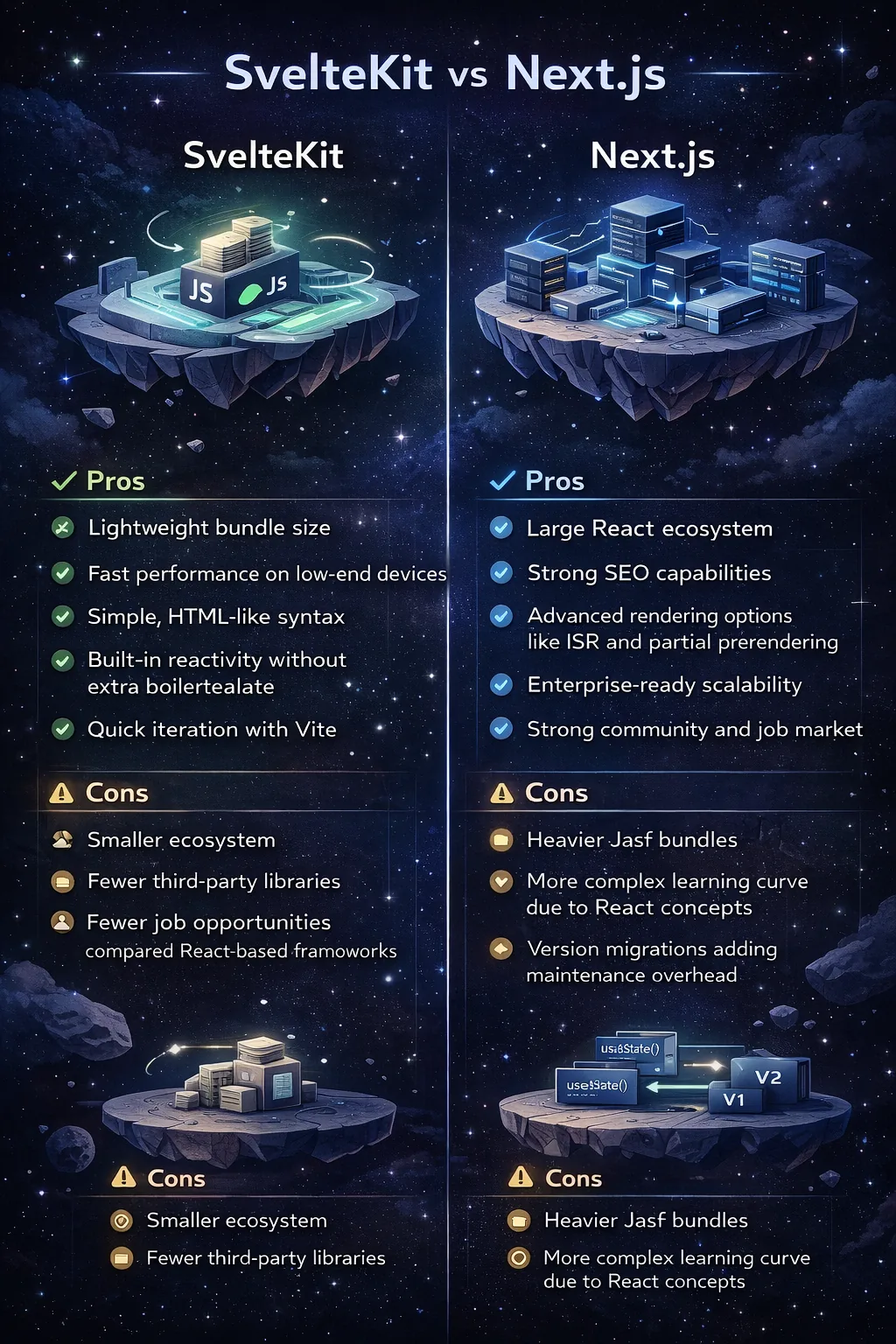
Next.js Pros:
- Vast ecosystem for quick integrations.
- Strong SEO and performance tools like ISR.
- Job market dominance.
- Frequent, backward-compatible updates.
- Easy Vercel deploys.
Cons:
- Heavier bundles impact mobile.
- React learning curve.
- Version migrations can be tedious.
SvelteKit Pros:
- Superior speed and small sizes.
- Intuitive syntax for faster dev.
- Built-in reactivity.
- Vite for rapid feedback.
- Rising adoption for efficient builds.
Cons:
- Smaller library pool.
- Fewer jobs than React.
- Less mature for some edge cases.
When to Choose SvelteKit Over Next.js
Opt for SvelteKit if:
- Performance on low-end devices is priority.
- You're solo or in a small team valuing simplicity.
- Building MVPs or interactive UIs.
- Prefer compiler magic over runtime overhead.
Choose Nextjs if:
- Your team knows React.
- Need SEO-heavy or e-commerce features.
- Value a huge community for support.
- Handling complex, data-intensive apps.
No absolute winner, test both on a prototype. Check Next.js docs and SvelteKit docs for more details about this.
Future Outlook: Where They're Headed
As we look ahead from 2026, both Next.js and SvelteKit are poised for continued evolution, building on their strengths to address emerging web development challenges like edge computing, AI-driven applications, and stricter performance demands. Rather than static predictions, developers can anticipate practical advancements that make building scalable, efficient apps even more accessible.
For Next.js, the focus remains on deepening its integration with React's ecosystem while pushing boundaries in edge computing and full-stack capabilities. With Vercel's backing, expect enhancements in serverless edge functions that reduce latency for global users, making it ideal for high-traffic apps like e-commerce or content platforms. AI integrations are ramping up, think built-in support for server-side AI processing via tools like Vercel AI SDK, allowing seamless incorporation of machine learning models for personalized content generation or real-time data analysis without bloating client-side code. Job market dominance will persist, with projections showing steady growth in enterprise adoption, but innovations like improved migration paths from older versions will help teams scale without friction. If you're in a React-heavy environment, look forward to Next.js becoming even more of a "platform" than a framework, with automated optimizations for Core Web Vitals and hybrid rendering strategies that blend static and dynamic elements effortlessly.
SvelteKit, on the other hand, is accelerating toward mainstream enterprise use, with its compiler-driven efficiency attracting teams tired of runtime overhead. By leaning into web standards like signals (via its runes system), it promises predictable reactivity that's easier to debug and share across components. Anticipate roadmap items like native web components for reusable, standards-compliant elements that integrate smoothly with other frameworks, reducing vendor lock-in.
Final Thoughts
In wrapping up this deep dive into SvelteKit and Nextjs in 2026, it's clear these frameworks embody the pinnacle of modern web development, each excelling in ways that complement the other's strengths.
Ultimately, there's no universal "better" choice; it hinges on your project's DNA. If bundle size, developer happiness, and low overhead are king, especially for mobile or bandwidth-constrained users, SvelteKit edges ahead in benchmarks (1,200 requests/second vs. Nextjs's 850) and satisfaction surveys (71% vs 69%). For SEO-heavy sites, e-commerce, or integrations galore in a React-savvy team, Next.js's ecosystem and full-stack prowess provide the scalability and support to handle growth without headaches. Both nail essentials like file-based routing, SSR/SSG hybrids, and API building, while adapting to 2026's demands for edge and AI. Assess your skills, test a prototype, and remember: the true victory isn't the framework, it's shipping a fast, engaging app that users love. Dive into their docs, experiment, and build something great.
Windframe is an AI visual editor for rapidly building stunning web UIs & websites
Start building stunning web UIs & websites!