Svelte vs React: A Detailed Comparison to Help You Choose the Right Framework in 2026
By Emmanuel Chinonso - Frontend Engineer and Technical Writer at Windframe

Choosing between Svelte and React can feel overwhelming when starting a new web project. Both are popular JavaScript frameworks designed to build interactive user interfaces, but they take different paths to get there. React, backed by Meta, has dominated the scene for years with its component-based approach and vast ecosystem. Svelte, a newer entrant, focuses on compilation for leaner code and faster performance. This guide breaks down their differences, strengths, and weaknesses in detail, using simple explanations and examples to make it accessible for beginners. We'll cover everything from basic setup to advanced features, helping you decide which fits your needs based on factors like speed, ease of use, and scalability.
A Quick Overview of React
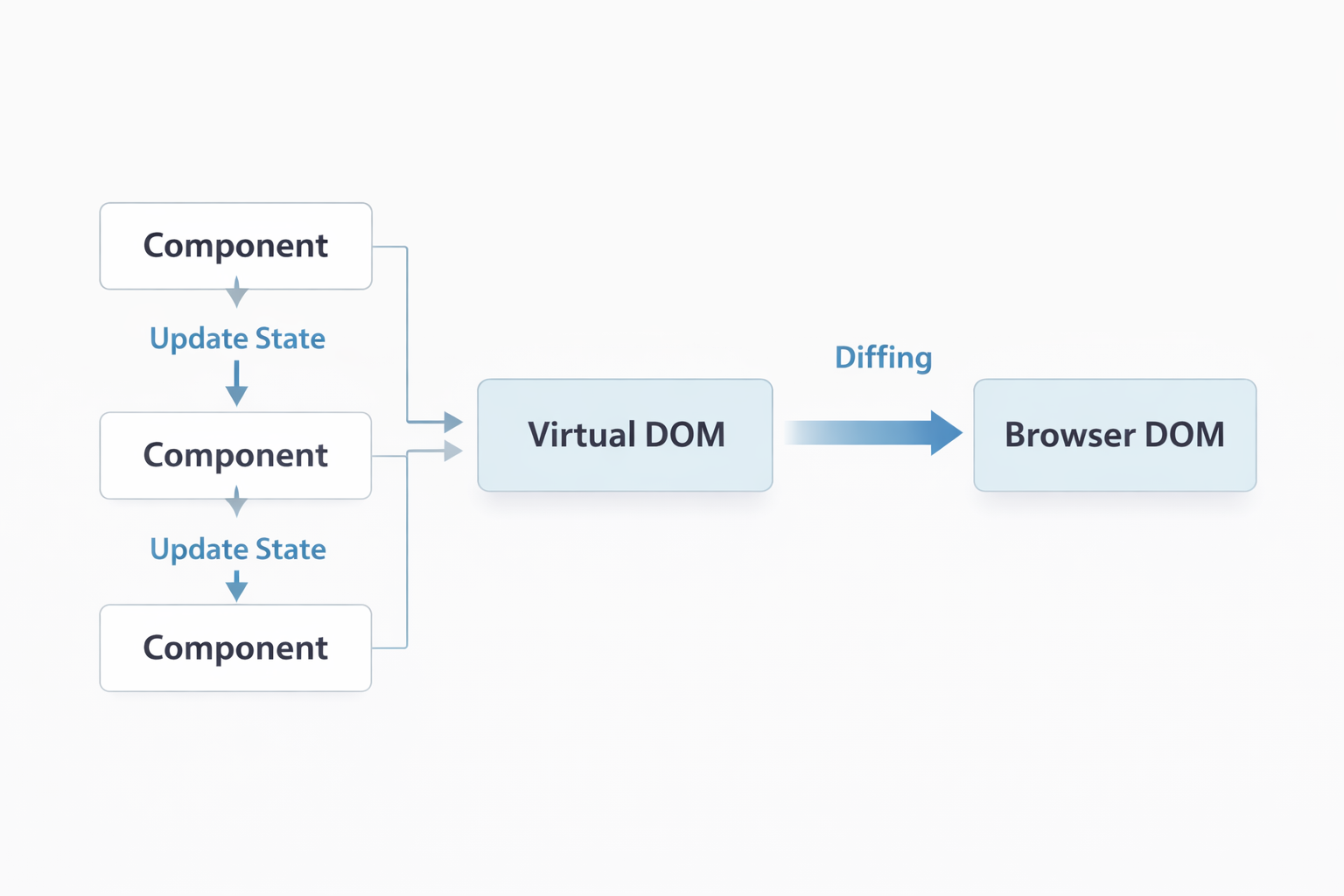
React is a library for building user interfaces, first released by Facebook (now Meta) in 2013. It introduced the concept of declarative programming, where you describe what the UI should look like based on state, and React handles the updates. At its core is the virtual DOM, a lightweight copy of the real DOM that React uses to efficiently detect and apply changes.
This means when data changes, React compares the virtual DOM with the real one and only updates what's necessary, reducing unnecessary re-renders. React's philosophy is "learn once, write anywhere," allowing it to power web apps, mobile apps via React Native, and even desktop apps.
For beginners, React's appeal lies in its flexibility. You can start small, adding it to an existing page, or scale to full single-page applications (SPAs) with tools like Create React App or Next.js, each with different trade-offs in routing, performance, and scalability. However, it requires additional libraries for routing (React Router) or state management (Redux), which can add complexity.
React's popularity stems from its massive adoption, used by companies like Netflix, Airbnb, and Facebook itself. According to surveys, it's the most wanted framework among developers, with a huge job market. If you're new, the official React tutorial walks you through basics here.1
Introducing Svelte: The Compiler-First Framework
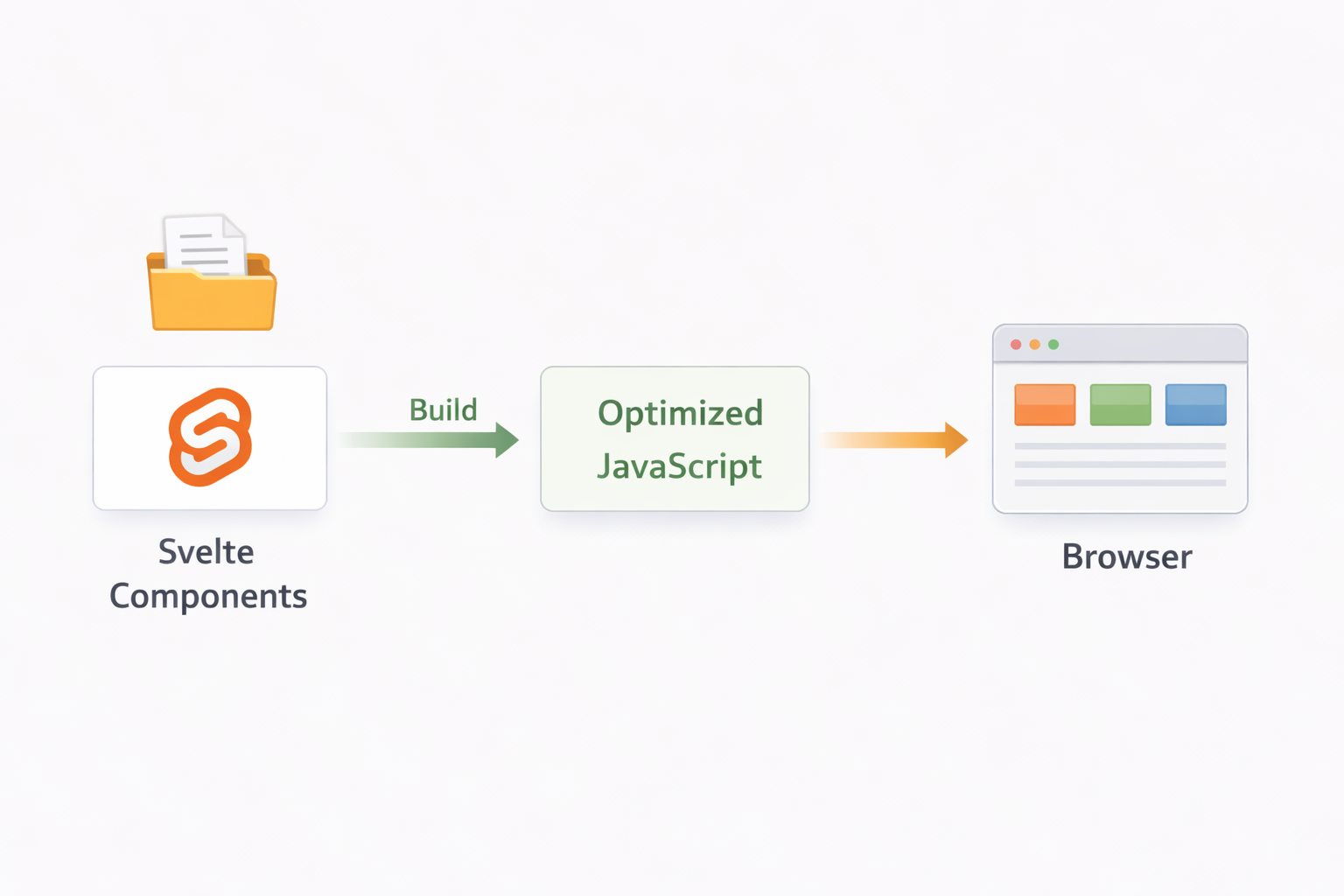
Svelte entered the scene in 2016, created by Rich Harris, formerly of The New York Times. Unlike React, Svelte is a compiler that turns your components into optimized vanilla JavaScript at build time. There's no runtime library interpreting your code in the browser, which leads to smaller bundles and quicker load times.
Svelte's approach is radical: It shifts work from the browser to the build step. When state changes, Svelte generates code that surgically updates the DOM, without a virtual DOM overhead. This makes apps feel snappier, especially on lower-end devices.
Components in Svelte are single files with HTML, CSS, and JavaScript together, similar to Vue. It's designed for simplicity, with built-in features like transitions and stores for state, reducing the need for extra packages. SvelteKit, its meta-framework, handles routing and server-side rendering out of the box.
While not as widely adopted as React, Svelte is gaining traction for its developer-friendly syntax and performance. Companies like Spotify and The New York Times use it for parts of their sites. Beginners can jump in with the Svelte tutorial here.2
Key Philosophical Differences
The biggest divide is how they handle updates. React's virtual DOM diffs changes and batches updates, which is efficient for complex apps but adds runtime cost. Svelte compiles reactivity into plain JS, eliminating that layer for better raw performance in simpler scenarios.
React is a library, giving you freedom but requiring more setup. Svelte is a framework with opinions, like scoped CSS by default, making it feel more batteries-included.
In terms of code style, React uses JSX (JavaScript XML) for templates, mixing HTML in JS. Svelte uses a templating language closer to HTML, with directives like {#if} for logic.
A Rootstack article highlights how Svelte's compilation leads to fewer dependencies compared to React's ecosystem reliance here.
Syntax and Code Structure: Side-by-Side Examples
Let's compare basic components to see the differences.
Hello World in React:
1import React, { useState } from 'react';23function Counter() {4 const [count, setCount] = useState(0);56 return (7 <div>8 <p>You clicked {count} times</p>9 <button onClick={() => setCount(count + 1)}>Click me</button>10 </div>11 );12}1314export default Counter;
Here, useState hook manages reactivity. JSX embeds HTML in JS.
Hello World in Svelte:
1<script>2 let count = 0;3</script>45<p>You clicked {count} times</p>6<button on:click={() => count += 1}>Click me</button>
Svelte's syntax is more HTML-like. Variables are reactive by default, no hooks needed. The <script> tag holds JS, and curly braces interpolate values.
For loops in React:
1<ul>2 {items.map(item => <li key={item.id}>{item.name}</li>)}3</ul>
In Svelte:
1<ul>2 {#each items as item}3 <li>{item.name}</li>4 {/each}5</ul>
Svelte feels less verbose. Conditional rendering follows suit: React uses ternary operators, Svelte has {#if} blocks.
Scoped styles in Svelte:
1<style>2 p { color: red; }3</style>
Automatically scoped to the component. In React, you might use CSS modules or styled-components.These examples show Svelte's aim for simplicity. A Shakuro comparison notes Svelte's lower boilerplate here.
Performance Benchmarks: Which is Faster?
Performance is a hot debate. Svelte often edges out in benchmarks due to no virtual DOM. Tests like JS Framework Benchmark show Svelte faster in DOM operations here.3
For real-world apps, Svelte shines in initial load and runtime efficiency. A Prismic analysis found Svelte apps up to 10x smaller, loading quicker on mobile.4
React, with optimizations like memoization, handles large-scale apps well. Its virtual DOM minimizes reflows in dynamic UIs. However, React's runtime (about 45KB minified) vs Svelte's near-zero adds overhead.
Recent 2024 benchmarks from Softteco confirm Svelte's advantage in small-medium apps, React for complex state.5
Bundle Size and Optimization
Svelte's compilation produces tiny bundles. A basic app might be 1-2KB gzipped, vs React's 40+KB plus app code. This matters for performance on slow networks.
React counters with code splitting and tree-shaking in tools like Webpack. Next.js adds server-side rendering (SSR) for faster perceived loads.
SvelteKit offers SSR too, with adapters for various hosts. A Konstantinfo table shows Svelte at 1.6KB base vs React's 42KB here.
Optimization tips: For React, use React.lazy for lazy loading. In Svelte, it's built-in with dynamic imports.
Learning Curve and Developer Experience
Svelte has a gentler curve, its syntax is close to vanilla web tech, with less abstraction. Beginners can build a full app in hours.
React requires understanding hooks, lifecycle, and ecosystem choices, which can overwhelm. However, abundant tutorials ease this.
Dev tools: React DevTools inspect components; Svelte has browser extensions. Vite powers Svelte's fast HMR (hot module replacement), often quicker than React's.
From Reddit, experienced devs prefer Svelte for fun, React for jobs.6A NamasteDev post rates Svelte easier here.
Ecosystem, Community, and Job Market
React's ecosystem is unmatched: Thousands of libraries for UI (Material-UI), forms (Formik), testing (Jest). NPM has millions of React-related packages.
Svelte's is growing but smaller, Svelte Material UI, Svelte Testing Library exist, but fewer options. Community: React has 200k+ GitHub stars, Svelte 70k+. Jobs: React dominates listings on Indeed/LinkedIn. Svelte jobs are niche, often in performance-critical areas.
State Management Approaches
React uses useState for local, Context/Redux for global. Redux adds boilerplate but scales. Svelte has built-in stores: writable for mutable state, readable for derived.Example Svelte store:
1<script>2 import { writable } from 'svelte/store';3 const count = writable(0);4</script>
Subscribe in components. Simpler than React's reducers.
For complex apps, React's options are more mature. A YouTube discussion with Rich Harris notes Svelte's edge in simplicity here.
Use Cases and Real-World Examples
React suits large, dynamic apps, social media platforms (Facebook), streaming services (Netflix), and e-commerce systems (Shopify), especially when paired with Node.js on the backend for full-stack development.
Svelte excels in lightweight, performant sites: Interactive news (NYT), games, or embedded widgets.
Case study: Spotify uses Svelte for some UIs due to speed. React powers Airbnb's search. For startups, Svelte accelerates MVPs; enterprises favor React's stability.
Pros and Cons Breakdown
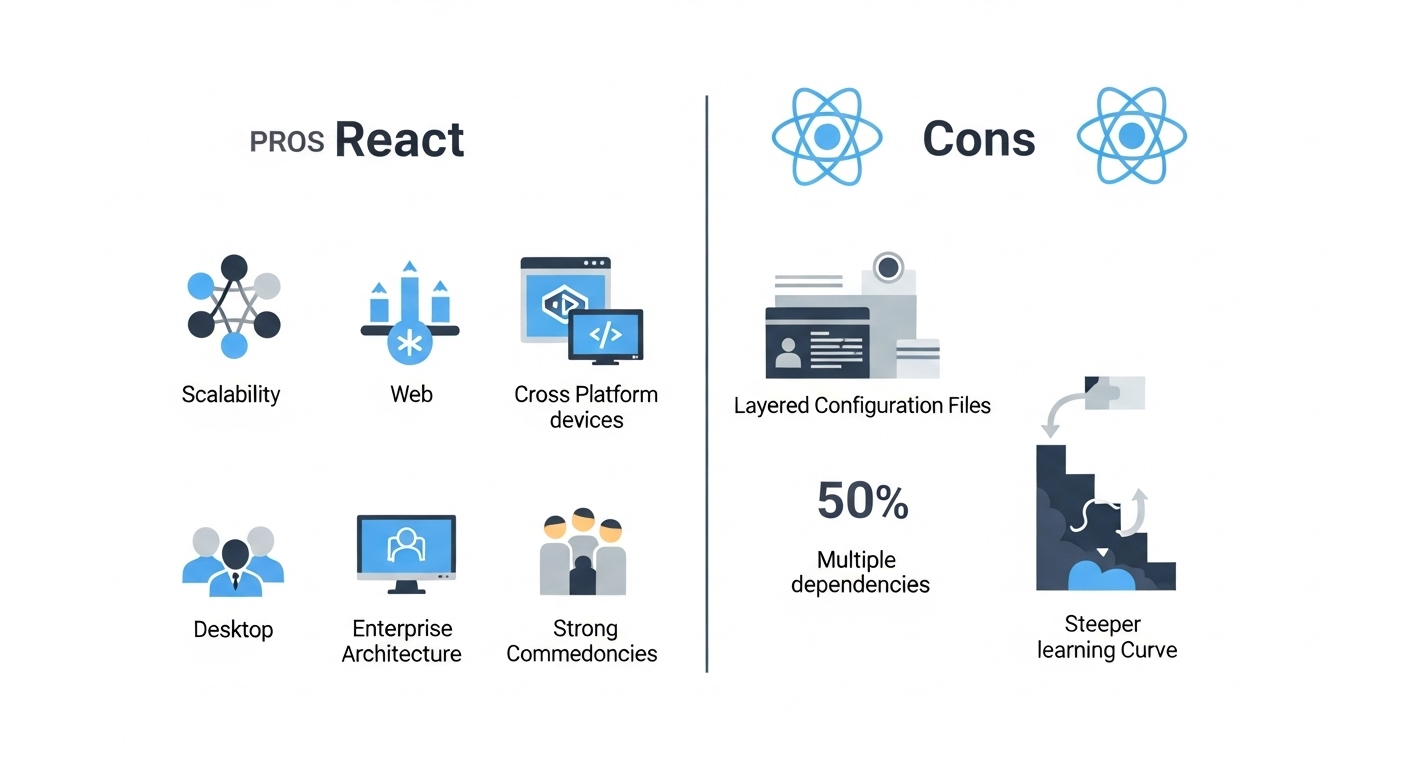
React Pros:
- Massive community/support
- Rich ecosystem
- Cross-platform (Native, Electron)
- Battle-tested scalability
React Cons:
- Steeper learning
- Larger bundles
- Boilerplate for basics
- Performance overhead
Svelte Pros:
- Excellent performance/small size
- Simple syntax
- Built-in features
- Fast development
Svelte Cons:
- Smaller ecosystem
- Fewer jobs
- Less mature for huge apps
- Migration challenges
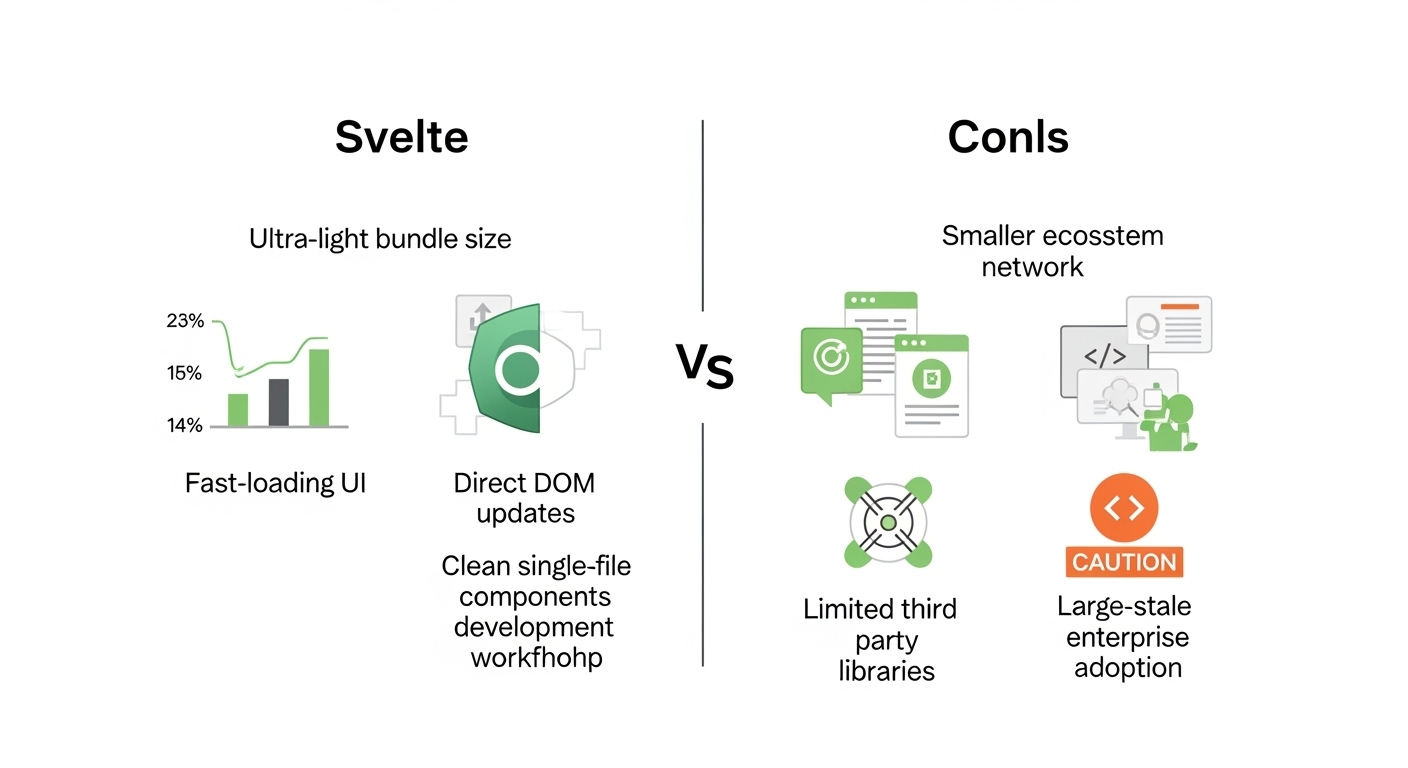
Tables from sources like Softteco summarize this here.
When to Choose Svelte Over React
Pick Svelte for performance-critical apps, small teams, or when bundle size matters (PWAs, mobile web). If you value simplicity and quick prototyping, it's ideal.
Choose React for enterprise projects, where ecosystem and talent pool are key. If building for mobile/desktop too, React Native extends it.
Future Outlook for Both Frameworks
React evolves with concurrent mode for better UX. Svelte 5 introduces runes for finer reactivity control. Trends show Svelte rising in surveys, but React holds dominance.
Wrapping Up the Comparison
As we close this in-depth look at Svelte versus React, it's clear both frameworks bring unique strengths to the table, shaping the landscape of web development in 2026 and beyond. React's enduring dominance comes from its robust ecosystem, proven scalability, and widespread industry adoption.
On the flip side, Svelte's innovative compilation model stands out for delivering exceptional performance with minimal overhead, ideal for projects where speed and efficiency are paramount.
Svelte and React both excel, but your choice depends on project needs, team skills, and goals.
Windframe is an AI visual editor for rapidly building stunning web UIs & websites
Start building stunning web UIs & websites!