PostgreSQL vs MongoDB: Which Database Should You Choose for Your Project
By Emmanuel Chinonso - Frontend Engineer and Technical Writer at Windframe
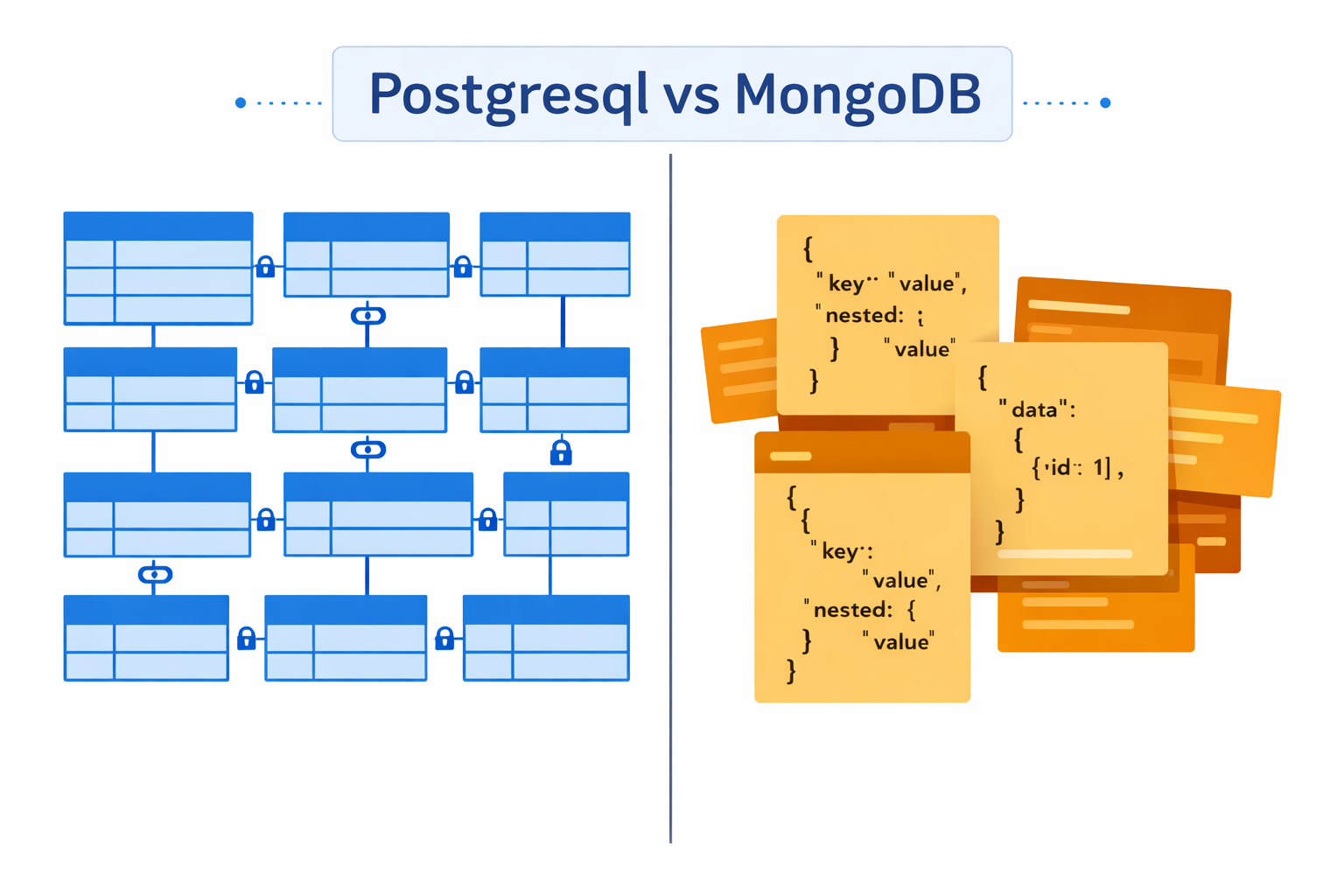
Every developer hits this crossroads at some point. You are starting a new project — or inheriting one, and the database question lands. PostgreSQL or MongoDB? Relational rows and tables, or nested JSON documents? The internet is full of answers that make the choice sound obvious. "Use MongoDB for flexible data." "Use PostgreSQL if you need transactions." Both rules are outdated. In 2025 and 2026, the gap between these two databases has collapsed in ways that make the decision harder and more nuanced than it has ever been. This guide cuts through that noise and helps you make a deliberate, defensible choice for your specific project.
You Probably Already Have the Wrong Mental Model
Most developers learn the relational vs. NoSQL divide through one simplified frame: PostgreSQL is structured and rigid, MongoDB is flexible and schema-free. That was roughly accurate around 2014. Today it is mostly a myth.
PostgreSQL 17 shipped in September 2024 with native JSON_TABLE support, incremental backups, improved parallel query execution, and a pgvector 0.8 update for AI workloads.
MongoDB 8.0 shipped the following month with enhanced sharding, expanded queryable encryption, and major Atlas Vector Search upgrades. Both databases have been quietly borrowing from each other's strengths for years.
PostgreSQL stores JSON natively with full indexing and query support. MongoDB now supports multi-document ACID transactions across sharded clusters. The real choice is not between a rigid system and a flexible one, it is between two philosophies about where complexity should live: enforced by the database, or managed by your application code.
What PostgreSQL Actually Is
PostgreSQL is a relational database. When you store data relationally, you are saying that the connections between records are as important as the records themselves. A user has many orders. An order belongs to one customer. A product appears in multiple orders. Those relationships, enforced by foreign keys, protected by constraints are the core feature, not a side effect.
Beyond strict relational work, PostgreSQL has grown into a multi-purpose data platform. Native JSONB indexing, pgvector for AI embeddings, PostGIS for geospatial queries, and TimescaleDB for time-series data all live in the same ecosystem. If you want one database that handles structured data, semi-structured JSON, vector search, and analytics without standing up a second system, PostgreSQL covers it.
JSONB: The Feature That Changed the Conversation
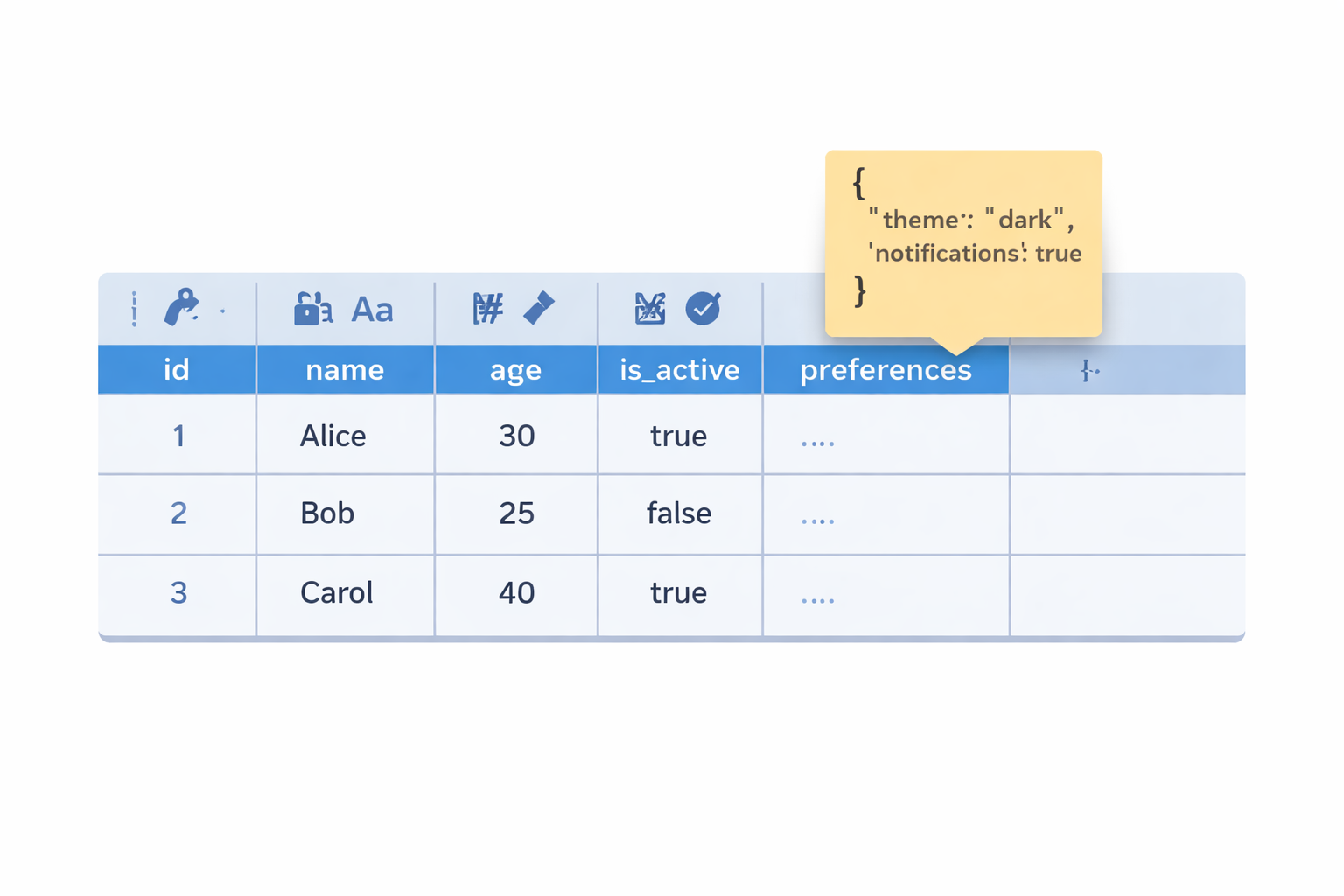
JSONB is PostgreSQL's binary JSON storage format. Unlike plain JSON columns, JSONB is stored in a way that allows direct indexing and querying on nested fields. This gives you a column-level choice. Define a strict, typed schema for fields that need guarantees, unique emails, decimal payment amounts, enumerated order statuses, while using JSONB columns for the parts of your data that genuinely vary between records. A user's preferences object, product attributes that differ by category, or feature flags that change weekly can live in JSONB while the rest of your schema stays typed and constrained. Indexes, path operators, and full-text search all work on JSONB fields. You get flexibility where you need it without surrendering relational integrity everywhere else.
What Changed in PostgreSQL 17 and 18
PostgreSQL 17 delivered several changes with real production impact:
The JSON_TABLE() function converts JSON data directly into a relational table, letting you run SQL joins and aggregations against JSON fields without extra parsing code. Incremental backups arrived natively via pg_basebackup --incremental with the pg_combinebackup utility, a long-standing operational gap now filled without third-party tools like pgBackRest or Barman. A new memory management system for VACUUM significantly reduces memory consumption during maintenance operations. Write throughput improved under high concurrency, and sequential reads got faster through a new streaming I/O interface.
PostgreSQL 18 released in September 2025, continuing the annual cadence that has kept the project moving without breaking production systems.
What MongoDB Actually Is
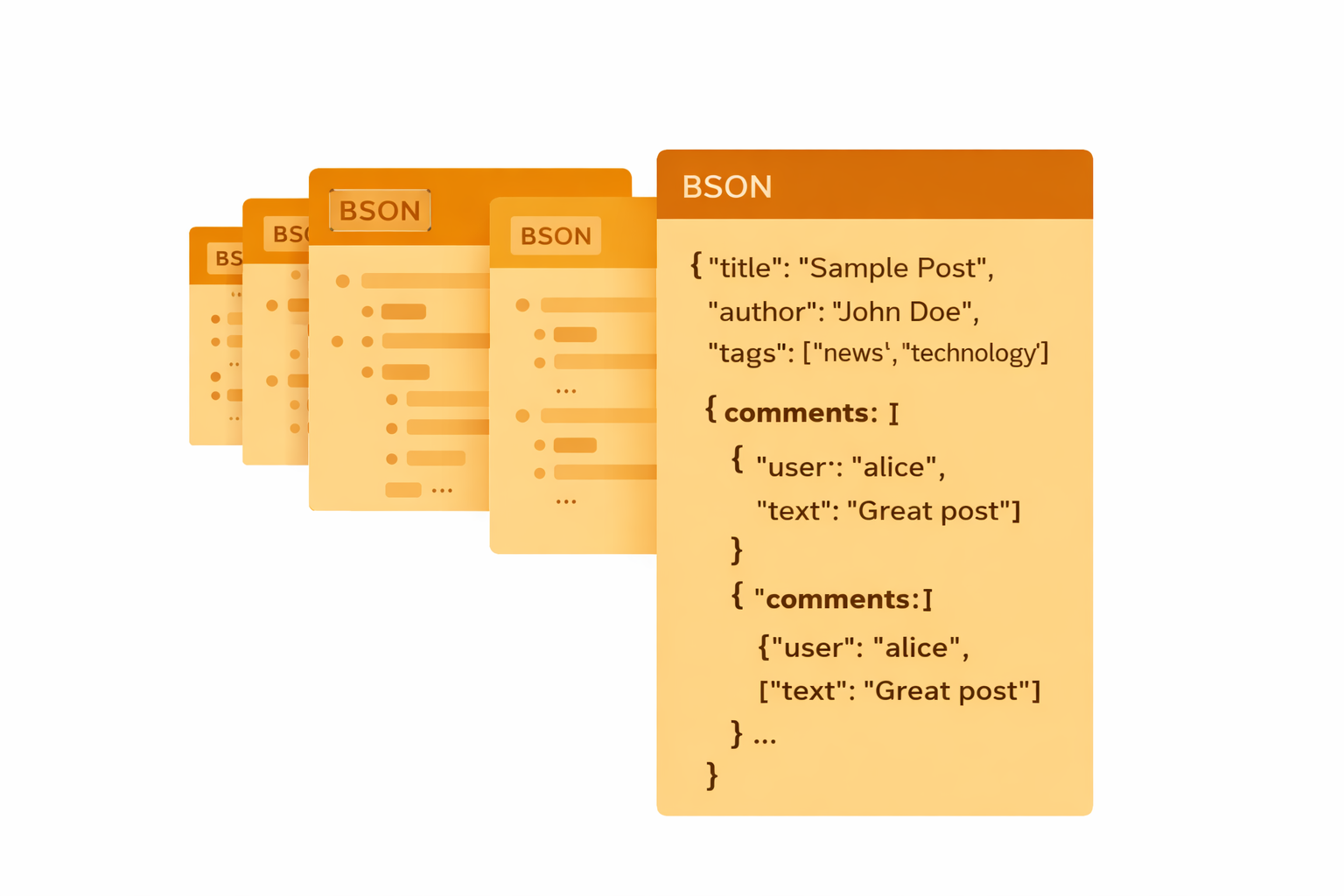
MongoDB is a document database. Where PostgreSQL stores rows, MongoDB stores documents, JSON-like objects in a binary format called BSON, that can contain nested arrays, embedded sub-documents, and any structure you can express in JSON.
The core idea: a document represents a complete logical entity. A blog post with its title, author, tags, comments, and metadata lives in one document. You read it in a single operation, write it in a single operation, and never need a join to reconstruct it. For access patterns where you almost always fetch the whole object together, that is genuinely efficient.
What Changed in MongoDB 8.0 and 8.2
MongoDB 8.0 delivered architectural changes that boost read performance by 36% and update throughput by 59%. Sharding improvements distribute data across shards up to 50 times faster at up to 50% lower starting cost, a significant operational improvement for horizontally scaled deployments. Queryable Encryption expanded to support range queries, meaning applications can now run expressive queries on encrypted sensitive data without decrypting it server-side.
On the vector search side, MongoDB 8.0 added quantized vectors to Atlas Vector Search, compressed representations of full-fidelity vectors that require 73% to 96% less memory while preserving search accuracy, making large-scale AI applications significantly cheaper to run.
MongoDB 8.2 brought capabilities previously exclusive to MongoDB Atlas into self-managed Community Edition and Enterprise Server: full-text search, vector search, hybrid search, and expanded Queryable Encryption with prefix, suffix, and substring query support. For teams running on-premises or in private clouds, this is a material change.
The Myth of the Schema-Free Database
MongoDB is not actually schema-free in practice. The moment your application reads a document and expects userId to be a string, you have a schema. It lives in your application code rather than the database. When a document arrives with userId as an integer, or missing entirely, your application crashes, and the database had no mechanism to warn you.
MongoDB's schema validation has grown more capable, you can define JSON Schema rules at the collection level to enforce types and required fields. But the enforced-in-database model and the enforced-in-code model produce genuinely different experiences at scale, especially across large teams or long-lived codebases.
The ACID Transaction Question
ACID stands for Atomicity, Consistency, Isolation, and Durability, the guarantees that make database transactions reliable. Transfer $500 from one account to another, and ACID ensures either both the debit and credit happen, or neither does. No partial states. No corruption from a crash mid-write.
PostgreSQL has always been ACID-compliant at its core. Every transaction, every write. It is not a mode you enable, it is how the system is built. MongoDB added multi-document ACID transactions in version 4.0 (2018) and has improved them since. They work, but they carry overhead. More importantly, MongoDB's document model is designed to minimize the need for cross-document transactions by embedding related data within a single document. The moment your queries regularly span multiple collections with strict consistency requirements, you are working against the grain of the document model. For standard CRUD operations in most web applications, this difference is invisible. For financial systems, inventory management, reservation systems, or anything where a partial write produces corrupted state, PostgreSQL's transaction model is the right default.
Scaling: Where the Real Difference Still Lives
Horizontal scaling , distributing data across multiple servers, was MongoDB's clearest architectural advantage for years. PostgreSQL was designed to scale vertically: more RAM, faster CPU, bigger disk. MongoDB was built to shard: add servers and spread load across them automatically.
The gap has narrowed but has not closed. PostgreSQL scales horizontally through extensions and managed infrastructure, Citus for distributed queries, Supabase and Neon for serverless deployments, AWS Aurora for cloud-managed horizontal reads. For most web applications, vertical scaling with read replicas covers far more ground than developers expect before hitting a genuine horizontal limit.
MongoDB's built-in sharding remains the more direct path when massive write throughput is a day-one requirement, ingesting IoT sensor data from millions of devices, storing billions of user events, or running a global platform where write latency across continents matters. If you genuinely need that scale, MongoDB's sharding is purpose-built for it.
The practical baseline: start with PostgreSQL. Add JSONB where your data is fluid. If you hit a scaling wall that read replicas and table partitioning cannot solve, then evaluate MongoDB or PostgreSQL with Citus.
How They Compare Side by Side
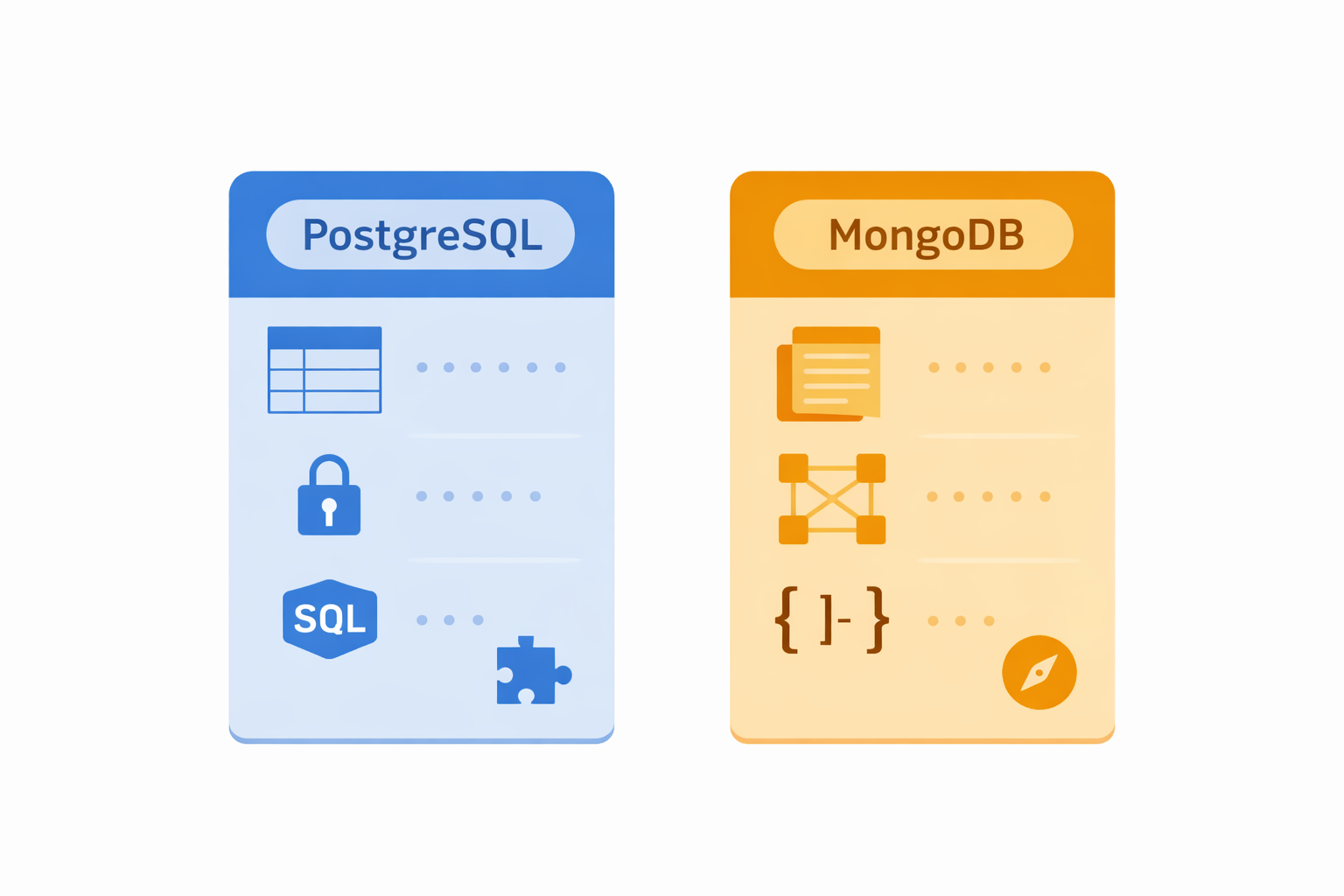
| Dimension | PostgreSQL | MongoDB |
|---|---|---|
| Data model | Relational tables with optional JSONB | BSON documents (JSON-like) |
| Schema | Enforced at database level | Flexible; validation optional |
| ACID transactions | Built-in, always on | Multi-document support (v4+) |
| Horizontal scaling | Via Citus or managed services | Built-in sharding |
| JSON handling | JSONB with full indexing | Native — it is the core model |
| Query language | Full SQL standard | MongoDB Query Language (MQL) |
| Vector search | pgvector, integrated into query planner | Atlas Vector Search |
| Licensing | Open source, fully free | Server-Side Public License (SSPL) |
| Best for | Structure, integrity, analytics | Flexible schemas, massive writes |
Tooling and Ecosystem: The Part That Hits Daily
You will spend more time with your database through a query layer than you will ever interact with it directly. The ecosystem shapes your daily experience in ways that benchmark numbers never capture.
PostgreSQL has first-class support in virtually every major ORM: Prisma, Drizzle ORM, SQLAlchemy, ActiveRecord, Hibernate, and GORM. Drizzle has seen strong adoption in 2025 among TypeScript developers for its type-safe query builder that gives the ergonomics of an ORM with the transparency of raw SQL. Every major BI tool, Metabase, Grafana, Tableau, Power BI, Redash, speaks SQL natively, which means connecting PostgreSQL to an analytics stack is almost always straightforward.
MongoDB's Mongoose remains the dominant ODM for Node.js with solid TypeScript support. For JavaScript-native teams where the mental model of working with objects already matches how they think about data, the MongoDB and Mongoose experience is genuinely ergonomic. The friction of mapping JavaScript objects to SQL rows is real, and MongoDB eliminates it.
The AI Workload Question
Both databases have made serious investments in vector search — storing numerical embeddings and finding semantically similar records. Where they differ is in how that search fits into the broader query.
PostgreSQL's pgvector is integrated directly into the query planner. The optimizer understands vector indexes the same way it understands B-tree indexes and can combine them in a single execution plan.
A query like "find all electronics products with an embedding similar to this search vector where price is under $200" runs in one pass, with the planner optimizing across all conditions together.
MongoDB Atlas Vector Search is mature and, as of MongoDB 8.2, available in self-managed environments without an Atlas subscription. With quantized vector support reducing memory requirements by up to 96%, it scales to billions of vectors at lower infrastructure cost.
For teams building RAG (Retrieval-Augmented Generation) pipelines primarily over unstructured content, articles, product descriptions, support transcripts, where semantic search dominates the workload, MongoDB's document model and vector search work naturally together.
The dividing line: if your AI workload sits alongside structured operational data with joins and transactions, pgvector inside PostgreSQL is cleaner. If your AI workload is primarily over unstructured content with minimal relational requirements, MongoDB Atlas Vector Search is a solid fit.
When PostgreSQL Is the Right Call
Your data has relationships that matter. Users belong to organizations. Orders reference products and customers. If your data model depends on foreign key enforcement and relational integrity, PostgreSQL is built for exactly that, the relational model is the feature, not the constraint.
You need complex querying. Window functions, CTEs, lateral joins, aggregations across multiple joined datasets, SQL is more expressive for analytical work than MongoDB's aggregation pipeline.
You are in a regulated industry. Financial services, healthcare, legal, anywhere with data integrity requirements and audit obligations. ACID compliance baked into the architecture matters more than ACID compliance available as an option.
Your team knows SQL. A team fluent in SQL will build faster, debug faster, and write more maintainable queries in PostgreSQL than they will learning MQL under delivery pressure.
You want one system for multiple workloads. TimescaleDB for time-series, PostGIS for geospatial, pgvector for AI embeddings, JSONB for flexible metadata, PostgreSQL's extension ecosystem covers most workload types without a second database to operate.
When MongoDB Is the Right Call
Your data is genuinely document-shaped. Product catalogs where a laptop has different fields than a coffee maker. User profiles that gain new fields with each feature release. Content with deeply nested structures that would require many joined tables to represent relationally. When the natural unit of your data is a self-contained object, the document model is correct.
Your schema is still moving. Early-stage products where the data model changes weekly are painful in a relational database. Every ALTER TABLE is a migration script, a deployment step, and a potential source of downtime. MongoDB lets you push new document shapes without touching the database layer.
Write scale is a day-one requirement. Ingesting sensor data from millions of IoT devices, storing hundreds of millions of concurrent user events, building a global write-heavy platform, MongoDB's built-in sharding is purpose-built for this.
Your team is JavaScript-native. Node.js backend, object-first thinking, data that maps cleanly to documents, the MongoDB and Mongoose combination is ergonomic in a way SQL is not for this environment.
Real Projects, Real Choices
E-commerce: PostgreSQL for orders, inventory, payments, and customers, the relational integrity is load-bearing. MongoDB sometimes appears for product catalogs where attribute schemas vary significantly by category.
IoT and event ingestion: MongoDB handles write-heavy, high-volume event streams well. When those events need to feed reporting, cross-dataset aggregations, or joins against other data sources, PostgreSQL, often with TimescaleDB, produces cleaner results.
Content management: MongoDB is the natural fit. Articles, media assets, and user-generated content with variable structure map to documents without awkward schema gymnastics.
Financial systems: PostgreSQL, consistently. Transactional guarantees, constraint enforcement, and audit trail through logical replication run deeper in PostgreSQL's architecture.
SaaS backends: PostgreSQL is the dominant choice in 2025. Platforms like Supabase and Neon have made managed PostgreSQL nearly as operationally simple as MongoDB Atlas, which removes one of the historical reasons teams defaulted to MongoDB for early-stage products.
AI-powered applications: Split. RAG pipelines over unstructured content lean toward MongoDB Atlas. Hybrid applications with structured data plus vector search typically land on pgvector. The deciding factor is whether your data is primarily relational or primarily document-shaped.
What the Numbers Show
In the 2025 Stack Overflow Developer Survey, PostgreSQL is the most used database at 55.6% of respondents.1 MongoDB sits at 24.0%, dominant for NoSQL but significantly behind PostgreSQL overall. PostgreSQL roles saw roughly a 73% increase in job posting demand with a 12% salary premium over MySQL-focused positions, while MongoDB remains the leading NoSQL skill in JavaScript-heavy job postings.
Popularity is not a reason to pick a database on its own. But the adoption gap signals ecosystem maturity, community size, and the volume of answered questions you will find when something breaks at 2am.
Can You Use Both?
Yes, and many production systems do. The typical split: PostgreSQL as the relational core for users, billing, orders, and anything needing transactions and joins; MongoDB for specific workloads that genuinely benefit from document storage, product catalogs, activity feeds, content, real-time event ingestion.
The cost is operational complexity. Two databases means two backup strategies, two monitoring setups, two failure modes, and two skill sets. For a small team that overhead is real. For a team with database operations experience, it is manageable when the workload genuinely calls for it.
Six Questions That Cut Through the Noise
-
What shape is your data? If it decomposes naturally into rows and relationships, PostgreSQL. If it clusters into self-contained objects with variable fields, MongoDB.
-
What queries will you run? Complex joins, reporting, aggregations, use PostgreSQL. Single-document reads and writes with minimal cross-collection correlation, use MongoDB.
-
What are your transaction requirements? Anything financial or state-sensitive where a partial write creates corrupted data, PostgreSQL. Write-heavy ingestion where each document is the complete unit of work, MongoDB.
-
What does your team know? Match the technology to the team's existing fluency. The productivity cost of a learning curve under delivery pressure is not theoretical.
-
What are your scaling expectations? If you genuinely need to scale writes beyond what a single server can handle before you have the resources to manage a distributed system, MongoDB's built-in sharding is a real advantage. For most applications, PostgreSQL with read replicas and partitioning is sufficient.
-
How many systems can you operate? PostgreSQL's extension ecosystem covers more ground than most developers realize. If you can solve the problem with one system, solve it with one.
The Thing Nobody Puts in These Comparisons
Both databases are good. The horror stories about MongoDB, schema chaos, data consistency nightmares, "just throw it in Mongo" regret, come from misuse, not from the database itself. The horror stories about PostgreSQL, painful migrations, rigid schemas, slow schema evolution, come from the same place.
The single biggest factor in whether your database choice succeeds is whether your data model is designed well. A poorly structured MongoDB collection with inconsistent, deeply nested documents is a maintenance problem. A PostgreSQL schema with no indexes and no query monitoring is a performance problem. The tool does not rescue bad design.
Pick the database that matches your data's natural shape and your team's genuine strengths. Index the fields you filter on. Monitor the slow query log. Those habits matter more than which side of the SQL/NoSQL line you land on.
Where to Start
Starting with PostgreSQL: Supabase or Neon for managed hosting, Drizzle ORM or Prisma for TypeScript projects, psql for direct querying. The PostgreSQL documentation is thorough and actually readable, worth bookmarking before you need it.
Starting with MongoDB: MongoDB Atlas has a free-tier cluster running in minutes with a usable web UI. Mongoose is the standard ODM for Node.js. MongoDB University's free courses are worth the time for anyone new to the document model.
Migrating between them: Take the scope seriously. Moving from MongoDB to PostgreSQL usually means rethinking your data model, not just translating queries. Moving from PostgreSQL to MongoDB means deciding which schema enforcement moves into application code. Neither is a weekend project.
Pick something. Build with it. Learn where it fits. The worst outcome is two weeks of analysis paralysis while your competitor ships.
Windframe is an AI visual editor for rapidly building stunning web UIs & websites
Start building stunning web UIs & websites!